
By Kieran Haslett-Moore
Most of us started our brewing journey with a can of hopped extract, a dusty sachet of yeast under the lid and a bag of sugar. The first lesson most of us learnt was to ditch sugar and use two cans of extract instead. The brewing books and message boards were of one voice: the sugar will make your beer taste of cider and might even give you a hangover to match. Now as a lover and home producer of farmhouse cider, I take issue cider being the descriptor here but if we put that to one side, the conclusion was clear: drop the sugar.
This aversion to adding sugar to beer in homebrew circles along with American brewing’s German heritage, and its concept of brewing purity, meant that craft beer grew with a firm idea that full malt brewing was the correct, godly path.
The thing is sugar has a place in plenty of brewing traditions. It can be used in a highly refined state to lighten body, increase drinkability or, to use the Belgian term, add digestibility. It can also be used in British and Belgian tradition to add all sorts of flavours and aromas and colour to the beer.
Lighten Up
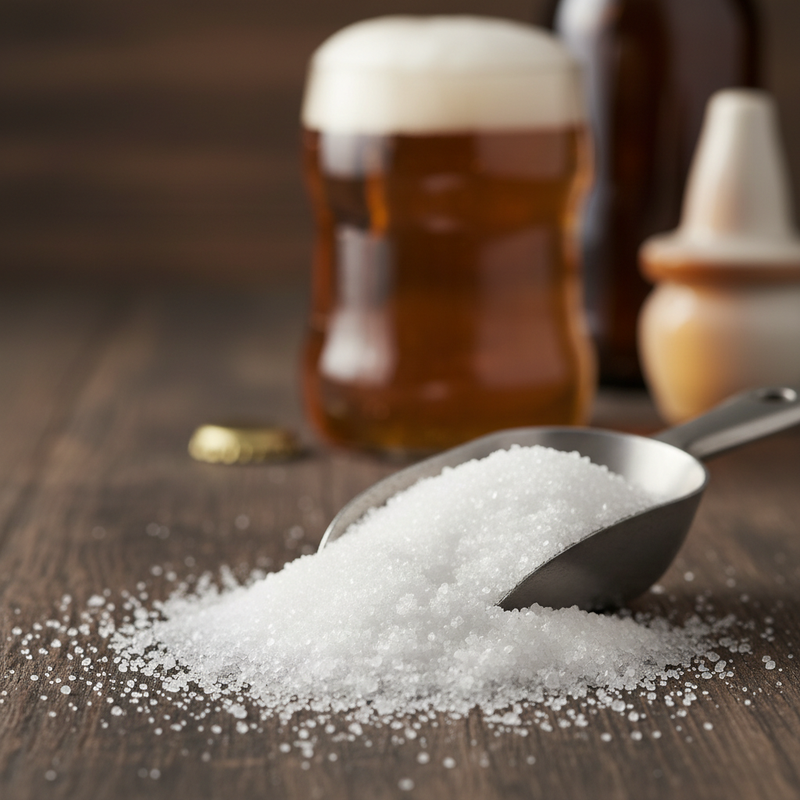
The first, most obvious way to use sugar in brewing is to lighten body. While to the uninitiated this seems counter intuitive, adding sugar before fermentation adds simple sugars which are completely fermented by the yeast leaving fewer residual sugars in the beer than a 100% malt beer of the same strength. In British brewing, the culture of pub session drinking means there is almost always an emphasis on drinkability. The priority of drinkability coupled with a (troubling) history of affordable slave-harvested sugar cane in British Empire plantations means there is a long tradition of using sugar in British beer. In Belgium, the sugar beet replaces the cane as the source of sugar but there the trend has been for high alcohol beers which deliver a warming punch while also avoiding being ‘chewy’.
Dextrose vs Table Sugar
When using sugar to lighten body, the common wisdom has been to use dextrose in place of cane sugar. Dextrose derived from corn contains a simple glucose molecule and is therefore more easily consumed by brewers yeast than cane sugar which has both glucose and fructose molecules. The fructose apparently being responsible for the “cider” character. I was always sceptical about this but in researching this post I did come across an exBEERiment post where they found there was a statistically relevant number of tasters who could tell the difference. More of them liked the cane sugar version than the dextrose version however, so make of that what you will!
Maillard Reaction of My Dreams
A more exciting use of sugar is to give flavour, aroma and colour to beer. The use of dark invert sugar in British brewing and dark candi sugar in Belgian brewing bring a whole palate of rummy, dried fruit, and golden syrup characters to the beers distinct from the character that malts bring. One reason that “craft” attempts at Belgian styles like dubbel or quadrupel seldom resemble the originals is that craft brewers try to achieve the character with specialty malts which it is in fact the dark caramelised sugars which make the Belgian examples. There is a theory which I subscribe to that the use of dark sugar spread from Britain to Belgium. Through the first half of the 20th century, the Belgian market imported a lot of British beer. Many of these beers achieved their dark amber, copper and brown hues from the use of dark invert sugar. Towards the end of this period, many of the classic dubbels and quadrupels we know today started to be brewed with a local take on invert sugar, candi sugar produced from sugar beets.
Invert Sugar
Dark invert sugar comes in three grades which refer to how much it has been caramelised. Number one is the lightest with number three the darkest. Dark invert sugar is, to my knowledge, not available here in NZ and even in Britain it comes in very homebrewer unfriendly 20kg blocks with a consistency like firm fudge. The good news is it is relatively easy to make, I make my own regularly. Raw or brown sugar, an acid and a little water is brought up to a boil and then put through a couple of temperature steps and held at a boil to caramelise for a set time. I use the following recipe:
- For 500g of sugar add 300ml of boiling water, 2ml of lactic acid and 2 tablespoons of good quality molasses to a pot. Stir to dilute.
- Turn on the heat and set the alarm on the candy thermometer to 110°C.
- Stir frequently while it starts to simmer.
- When the temperature hits 110°C, reset the alarm for 115°C.
- Heat slowly until the temperature gets to 115°C.
- Lower the heat to keep at 115° - 121°C.
- For No. 1 maintain the heat for 20 - 30 minutes.
- For No. 2 maintain the heat for 90 - 120 minutes.
- For No. 3 maintain the heat for 150-210 minutes.
- For No. 4 maintain the heat for 240 - 300 minutes.
Alternately you can use an oven proof pot and after the initial dilution and bringing to a simmer, you can caramelise it in a oven set to whatever temperature your oven needs to be at to maintain the mixture at 120c. You might need to experiment a little.
Candi Sugar
Belgian candi sugar is made in a similar way but traditionally it is from beet sugar and it uses an alkali rather than an acid. Food grade lye or caustic soda is available in NZ from Asian supermarkets (Chinese Century Eggs are produced with it) but take caution, it is highly corrosive and a spit of it will take your eye and never give it back. I haven’t made candi sugar before, however there is a good description and youtube video here.
I think Invert Number 3 would make a perfectly delicious dubbel or quadrupel with the much less dangerous lactic acid (also don’t get that in your eye!) than the lye.
Happy brewing beyond the malt mill.